Polo is the oldest team sport in the world. Records suggest that mounted nomads off Central Asia developed the sport as they migrated to Persia, with the earliest match taking place in 600 BC. Modern polo originated in Manipur, NE India. In the late 1850’s British military officers descovered Manipur emigrants playing the sport of sagol kanjei (horse stick). British officers, along with local tea planters, founded the Silchar Polo Club in India, the first in the world. A decade later, the British standardized the sport and gave it a set of written rules. James Gordon Bennett, publisher and editor of the New York Herald, brought it home after he had witnessed the game in Great Britian. He gathered interested horsemen, similar to those who founded the Surgarbush Club, and with equipment he had purchased in Britain, the sport of polo had its first American home, at Dickle’s Riding Academy in New York. The year was 1875.
Notable US players include Will Rogers, Spencer Tracy and Walt Disney, Gen. George Patton.
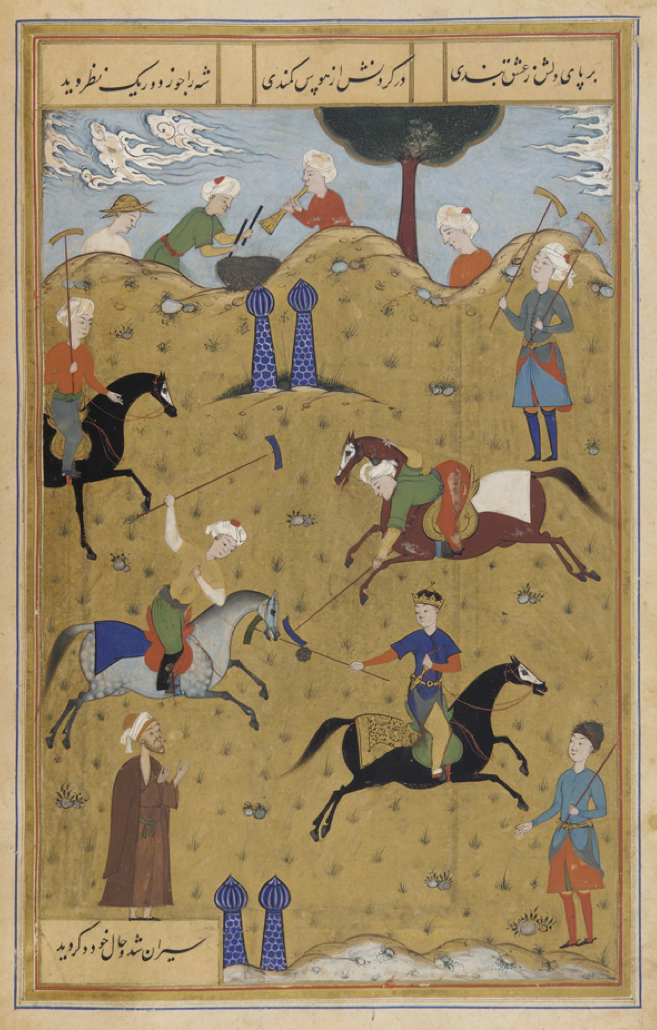
(Left) A Persian Minature from the poem “Guy-o-Chawgan” (The Ball and the Polo Mallet) dates back to the Safavid Dynasty of Persia and shows Persians on horseback playing polo in 1546 AD. (Wikipedia, image: Public Domain)
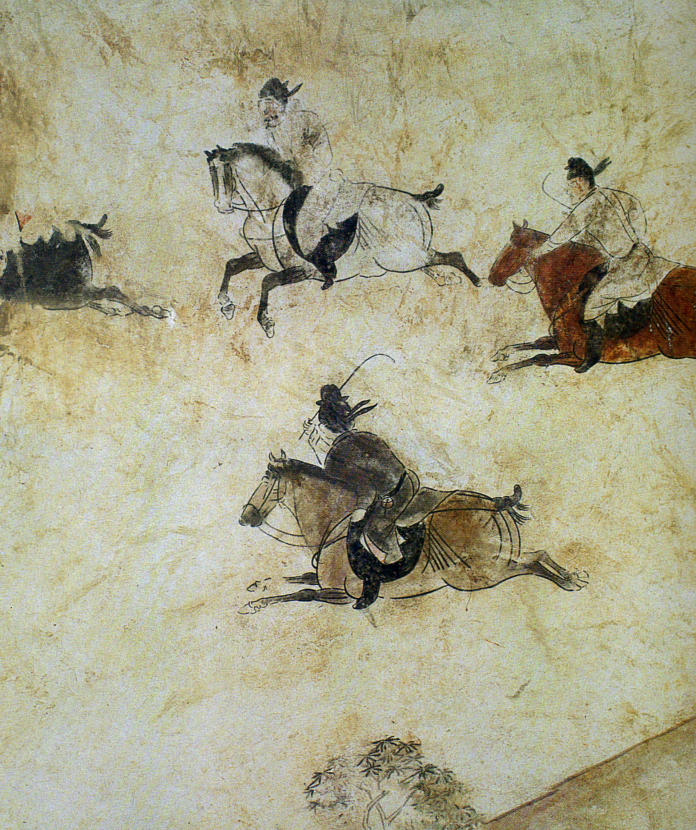
(Right) Chinese courtiers from the Tang Dynasty playing a game of polo, 706 AD. (Wikipedia, image: Public Domain)
Basic Game Set-up and Rules
A regulation field is 300 yards long and 200 yards wide
- There are 4 players on each team, 2 of which generally play offensive positions and 2 who defend the goal
- After a goal is scored, players change directions to make up for any wind, sun or field advantage
- In official tournaments, players are rated as follows: NOVICE, -2, -1, 0, and 1 through 10. Ten is the highest rating given.
- Polo ponies are really horses, although usually somewhat smaller than jumpers or hunters. Until 1910 no horses over 13.5 hands were allowed. The breed used is generally Thoroughbred or of Argentinian stock.
- Polo balls used today are made of a hard plastic or fiberglass instead of willow root wood which was used until 1970.
- Sticks, or mallets, are still made in the traditional way out of bamboo cane cut to the desired length. The head of the mallet is made from hard wood.
- At all times a right of way exists allowing the player most closely following the line of the ball to take a shot on his right side.
- No left-handed players are permitted on the field. Watson Webb, a 10-goal player from Shelburne, Vermont, was the last left-hander before the rule was changed.
- To impede another player, a player may “ride him off” the ball to spoil his shot or bump him in such a manner that it does not endanger the player or his mount. A player may also hook an opponents mallet as his is striking the ball.
- The most common penalty called is against a player crossing in front of another player who is following the line of the ball. No player may enter or cross this line unless he is at such a distance that the player on the ball does not have to check his pony.
Basic Plays
Of a good player it is said, “He hits well off all four corners of the pony.”
1. The Off-Side Foreshot 2. The Near-Side Backshot 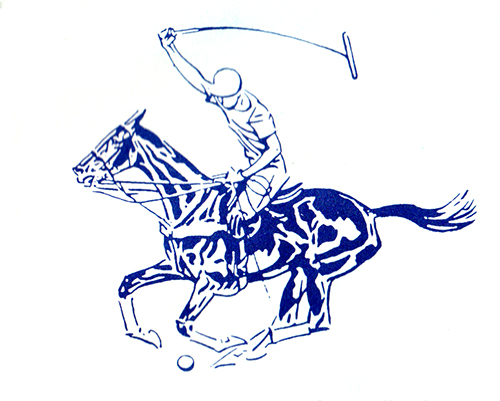 [/column] [column size=”1/2″ margin=”” last=”no”]3. The Near-side Forestroke
 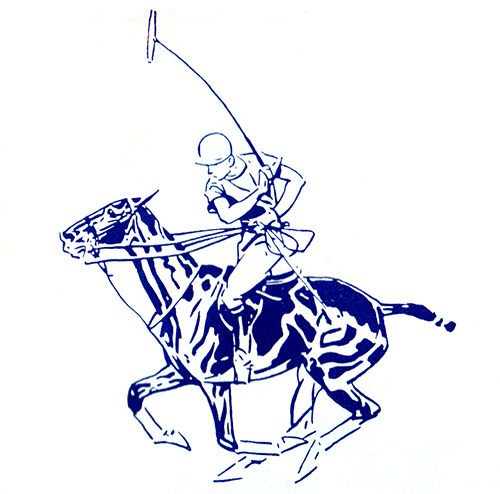 [/column] [column size=”1/2″ margin=”” last=”no”]4. The Off-side Neckshot